Academic Research
-
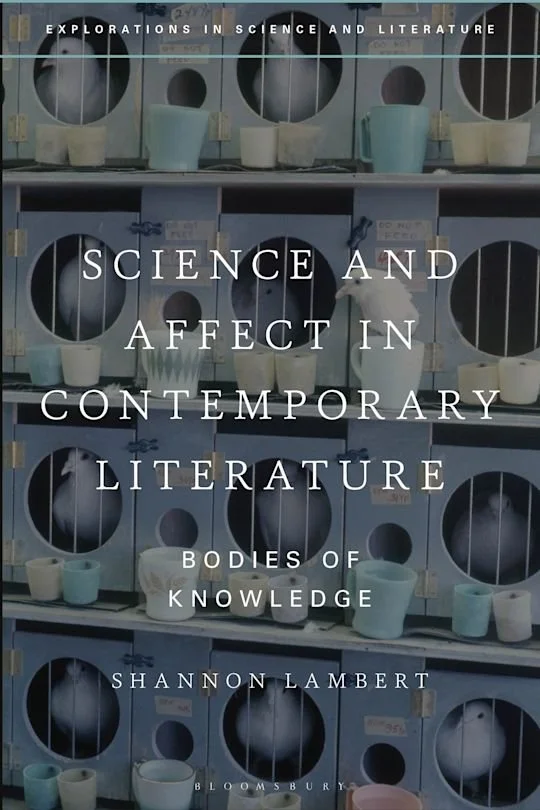
Shannon Lambert (she/her) is a researcher and lecturer in Anglophone literature at the University of Liège, Belgium. Her work focuses on intersections between literature and science with a particular focus on topics such as narrative and emotion in ecological (citizen) science, medicine and health, and representations of the environment and nonhuman animals in literature. She is the author of Science and Affect in Contemporary Literature: Bodies of Knowledge (Bloomsbury 2024), which won the 2025 British Society for Literature and Science Book Prize. Her work has been published in journals such as American Imago, ISLE, and SubStance. Beyond this, she is interested in creative-critical methodologies, questions of epistemic justice, and scientific communication.
Current Projects:
Ocean Entanglements: Encounters, Affect, and Care in Stories of Contemporary Marine Science: This project investigates how contemporary nonfictional and fictional prose, poetry, and drama represent and engage with marine science and how written reports from scientists and citizen scientists about the lived experience of participating in marine science complement and complicate fictional representations. The project’s key contention is that these stories of the sea foreground the importance of multispecies encounters in generating environmental knowledge and care, and that literature offers an important avenue for investigating such attachments and insights. It is currently being developed for funding.
Fictions of Bio-Messiness: Interspecies Ambiguity in the Experimental Forms and Spaces of Post-1945 Literature: This book project explores the ethical and aesthetic challenges of human-animal relationships in literature and biology; for example, ethics and administration in histories of medical experimentation, emotion, bias and fraud in science’s reproducibility crisis, writing the disabled body, CRISPR-Cas and unruly enhancement, biotechnology and AI, and animals in orbit and the planetary laboratory.
Botany and Bio-Tech: This project uses creative-critical methodologies to explore intersections between plants, procreation and eugenics in science and its representations. Using the framework of Science and Technology Studies (STS), it considers how colonialism, spectacle, and natural history speak to contemporary biotechnological projects in the field of reproductive medicine.
-
Forthcoming. Stuck in the Mud: Microbes, Genetic Science, and Friction in Susan M. Gaines’ Accidentals (2020). In Microscopic Life in 20th- and 21st-Century Literature and Performance, ed. Liliane Campos, Sarah Bouttier, Sarah Montin, and François-Joseph Lapointe. Open Book Publishers.
Forthcoming. Intimate Spaces: Humans, Animals, and (Un)Reproducible Affects in Literary Laboratories. Storyworlds, ed. Erin James, Eric Morel, and Brian J. McAllister.
2024. Science and Affect in Contemporary Literature: Bodies of Knowledge, Bloomsbury Press.
2023. With Marco Caracciolo: “The Scientific Lab: Sacrifice Zones as Contact Zones.” Textual Practice, vol. 37, no.10, pp.1568-1585.
2023. With Nathaniel Otjen, Lena M. Schelgel, Hannah Della Bosca, and Blanche Verlie. “Multispecies Grief in the Wake of Megafires.” Edge Effects (Violent Environments), 1 June. https://edgeeffects.net/multispecies-grief-megafires/
2022. “‘Shadowtime’: Michelle Paver’s Dark Matter and Ghosts of the Anthropocene.” English Text Construction, vol. 15, no.2, pp. 138-155.
2022. With Marco Caracciolo, Kristin Ferebee, Heidi Toivonen, and Gry Ulstein: “Climate Fiction: A Posthumanist Survey.” Interférences Littéraires, vol. 27, no.2, pp.6-21.
2022. “Experimental Bodies: Animals, Science, and Collectivity in Contemporary Short-Form Fiction.” Studia UBB Philologia, vol. 67, no. 2, pp. 89-111: 10.24193/subbphilo.2022.2.05.
2022. “The Stories of Somebodies: Collective Telling, Seeing, and Knowing in Natalya Bekhta’s We-Narratives.” Diegesis, vol. 11, no. 1, pp. 80-86: https://www.diegesis.uni-wuppertal.de/index.php/diegesis/article/download/437/622.
2021. “‘Fingereyeyed’ Description: Laboratory Animals and Transspecies Empathy in VanderMeer and Yanagihara.” SubStance, vol. 50, no. 3 (Issue 156), pp. 74-92: 10:1353/sub.2021.0029.
2021. “‘Mycorrhizal Multiplicities’: Mapping Collective Agency in Richard Powers’ The Overstory.” In Tracing Nonhuman Agency in 21st Century Literature, ed. Bettina Burger, Yvonne Liebermann, and Judith Rahn, pp. 187-209. Palgrave MacMillan.
2021. With Marco Caracciolo, Susannah Crockford, and Gry Ulstein: “Phenomenology of Everyday Climate: An Ethnographic Approach to Metaphor, Affect, and the Nonhuman.” ISLE: Interdisciplinary Studies in Literature and Environment. https://doi.org/10.1093/isle/isab006.
2021. “‘Contractions’: The Individual and Atmospheric in Offill’s Weather.” TERA Journal, vol. 1, no. 1, pp. 83-89. https://tera.institute/contractions/.
2020. “‘Agents of Description: Animals, Affect, and Care in Thalia Field’s Experimental Animals: A Reality Fiction (2016).” Relations, vol. 8, no. 1-2, pp.115-134.
2020. “Becoming-botanic: Vegetal Affect and Ecological Grief in Levy’s Swimming Home and Kang Han’s The Vegetarian.” In Trees in Literatures and the Arts: Humanarboreal Perspectives in the Anthropocene, ed. Carmen Concilio and Daniela Fargione, pp. 51-70. Lexington Books, Ecocritical Theory and Practice series.
2020. Review essay: Affective Ecocriticism: Emotion, Embodiment, Environment. Edited by Kyle Bladow and Jennifer Ladino. Lincoln: University of Nebraska Press, 2018. 343 pp. American Imago, ed. Stef Craps, pp. 223-31.
2019. “‘Machine Made of Earth’: Lively Automata in Marlowe’s Hero and Leander.” Cahier voor Literatuurwetenschap, Special Issue ‘Tegen de natuur? / Against nature?’ Ed. Sophie Wennerscheid, vol. 11, 2019, pp. 5-26.
2019. With Marco Caracciolo: “Narrative Bodies and Nonhuman Transformations.” SubStance vol. 48, no. 3, Issue 150, pp. 45-63.
2019. “‘Subversive Somatology’: Embodied Communication in the Early Modern Stag Hunt.” PUBLIC: Art, Culture, Ideas, vol. 59, pp. 78-87.
-
2026. Undernarrated / Underwater: Marine Fungi and the Limits of Myco-narratology. International Society for the Study of Narrative Annual Conference, 4-6 June.
2026. Forms of Resistance: Sea Stars, Stories, and Endless Regeneration in Loren Eiseley’s “Star Thrower” (1964). EASLCE Conference, Utrecht University, 14-17 April.
2026. ‘I see a starfish!’: Charting Excitement and Engagement in Online Marine Citizen Science Projects and Erin Hortle’s A Catalogue of Love (2025). British Society for Literature and Science Annual Conference, University of Strathclyde, Glasgow, 9-11 April.
2025. ‘I see a starfish!’: Charting Excitement and Engagement in Online Marine Citizen Science Projects. Invited Talk for Biocriticism Lecture Series, organised by Liliane Campos, online, 27 April.
2025. Dear Diary: The Weather, Emotion, and Epistolary Epistemologies in Women’s Environmental Writing. British Society for Literature and Science Annual Conference, Lancaster University, Lancaster, 10-12 April.
2025. Playing with Prompts: Participation, Ecology, and Emergent Narrative in Experimental Prose and Drama. International Society for the Study of Narrative, panel on Collective Storytelling in the Anthropocene, Miami, Florida, 4-7 April.
2024. The Edge of the Anthropos: Modernism, Mirrors, and Model Organisms. Australian Modernist Society, Modernism and Modernity at the Edge, The University of Tasmania, Hobart, 11-13 December.
2024. Gaps and Clues: Citizen Science and Ludic Ecological Knowledge. Class of Excellence Seminar with International Francqui Professor Ursula Heise, “Urban Biodiversity and Narrative,” Ghent University, Ghent, 13 November.
2024. Of Mirrors and Mice: Affective Ecologies and Human Bias in (Literary) Laboratories. Annual Colloquium on Hope, Uncertainty, and the Ecological Crisis, The University of Toronto, Toronto, 19 September.
2024. Reproducing Grief: Animal Experimentation, Loss, and Human Bas in Yaa Gyasi's Transcendent Kingdom. ShARC Tales Conference, University of Sheffield, 16-17 May.
2024. Webs of Affect: Citizen Science, Narrative, and the Joy of Discovery. Panel: Narrative and the Public Faces of Science, International Society for the Study of Narrative, 17-19 April.
2024. Webs of Affect: Citizen Science, Narrative, and the Joy of Discovery in the Short Stories of Andrea Barrett. International Conference of the Three Societies of Literature and Science, University of Birmingham, 10-13 April.
2023. ‘Stuck in the Mud’: Friction, Microbial Networks, and Citizen Science in Susan M. Gaines’ Accidentals (2020). Microscopic Imaginaries in 20th- and 21st-Century Literature, Institut Universitaire de France and the Sorbonne, Paris, 24 November.
2023. Ethics, Experimentation, and Containment in Hanya Yanagihara’s The People in the Trees. The European Association for Commonwealth Literature and Language Studies (EACLALS) Triennial Conference, Imagining Environmental Justice in a Postcolonial World, Paris, 6-10 June.
2023. “Fictions of Bio-Messiness: Animal Models and Forms in Keyes’ Flowers of Algernon and Fowler’s ‘Us,’” The British Society for Literature and Science, Edinburgh Napier University, Edinburgh, 13-15 April.
2023. “Experimental Animals: Science, Form, and Hybridity in Contemporary ‘Lab Lit.’” Guest Lecture, English, Creative Writing, and Film Studies 2023 Research Seminars, the University of Adelaide, Adelaide, 3 March.
2023. “Collaborating with Trees.” Invited response for Richard Grusin’s talk ‘Arboreal Infrastructures,’ Ghent University, 27 March.
2022. Care Bears: Symbols, Spectacles, and Affective Entanglement in Tawada’s Memoirs of a Polar Bear. Nature Feelz conference, the Sydney Environmental Institute, the University of Sydney, 6-7 December.
2022. Experiments with Dingo Thought: Poetic Fragments and Human-Animal Cognition in The Animals in That Country. ACLA conference, online.
2022. Literature and Science: Common Ground 2.0. Response for the event ‘Hope and Uncertainty: How We Talk about Ecological Catastrophe.’ University of Toronto, Toronto, 26 October.
2022. (with Marco Caracciolo) Bridges to Complexity: Narrative and the Problem of Interconnectivity in Science Education. International Exploratory Workshop for founding an Integrated Primary Education, Free University of Bozen-Bolzano, Bressanone. 27-29 June.
2020. Naturalistic Descriptions and Artificial Fictions: Animals in Laboratory Literature. International Society for the Study of Narrative (ISSN) Annual Conference, New Orleans, USA.
2020. “Agents of Description.” Towards an Understanding of Nonhuman Minds: From Animal to Artificial Agency Workshop, University of Zurich, June 24-25 and December 4, online.
2020. Experimenting with Experiments: Science, Narrative, and Bodily Knowledge in Contemporary ‘Lab Lit.’ European Society for Literature, Science, and the Arts (SLSAeu) Conference, “Anthropocene(s),” online.
2019. ‘Naturalistic Descriptions and Artificial Fictions’: Animals in Laboratory Literature. International Postgraduate Workshop on Ecocriticism and Narrative Form, 9-10th Dec, Graduate Center for the Study of Culture, Justus-Liebig Universität, Giessen, Germany.
2019. “Analogical Ecologies: Exploring Corporeality in Scientific Narratives.” International Society for the Study of Narrative (ISSN) Annual Conference, Universidad de Navarre, Pamplona.
2019. “‘Naturalistic Descriptions and Artificial Fictions’: Animals in Laboratory Literature.” Summer Course in Narrative Study (SINS), Aarhus University, Denmark.
2019. ‘Meating Places’: Meat, Corporeality, and the Limits of the Human. Association for the Study of Literature and the Environment (ASLE) Graduate Workshop with Prof. Greg Garrard.
2019. “Mycorrhizal Multiplicities: Mapping Collective Organisation in Richard Powers’ The Overstory.” Conference “Trees in/and/around Literature,” University of Turin.
2019. “Bodies of Knowledge: Representing Humans and Animals in Laboratory Literature.” LUCAS Graduate Conference, “Animals, Theory, Practice, and Representations,” Leiden University.
2018. “Mycorrhizal Multiplicities: Mapping Collective Agency in Richard Powers’ The Overstory.” Graduate Student Conference, “Tracing Non-Human Agency in Literatures in English,” Heinrich Heine Universität, Dusseldorf.
2018. “Slow Stories: Affective Experience in Plant Narratives.” International Society for the Study of Narrative (ISSN) Annual Conference, McGill University, CA.
2017. “Narrating the Mesh: Formal Solutions to Anthropocentric Challenges” (co-authored and presented), conference “Confronting Narratives of the Anthropocene,” University of Tampere.
2015. “Bagpipes and Bees: Becoming-Drone in Shakespeare’s The Rape of Lucrece.” ANZAMEMZ Biennial Conference, University of Queensland.
2014. “An Unbearable Sight: Early Modern Bear-Baiting and Becoming Animal.” ASLE-UKI conference, “Reading Animals,” University of Sheffield.
-
Interviews:
2022. “Accidentals: An Interview with Susan M. Gaines.” NARMESH Project, Ghent University.
2021. “Personhood: An Interview with Thalia Field.” NARMESH Project, online.
Talks:
2020. Talk on Richard Powers’ The Overstory for Ghent Institute of Classical Studies event “Listen. There’s something you need to hear,” online.
Field Notes:
2017. “A Day at the Helsinki Zoo.” NARMESH website. https://narmesh.ugent.be/blog.html